Import
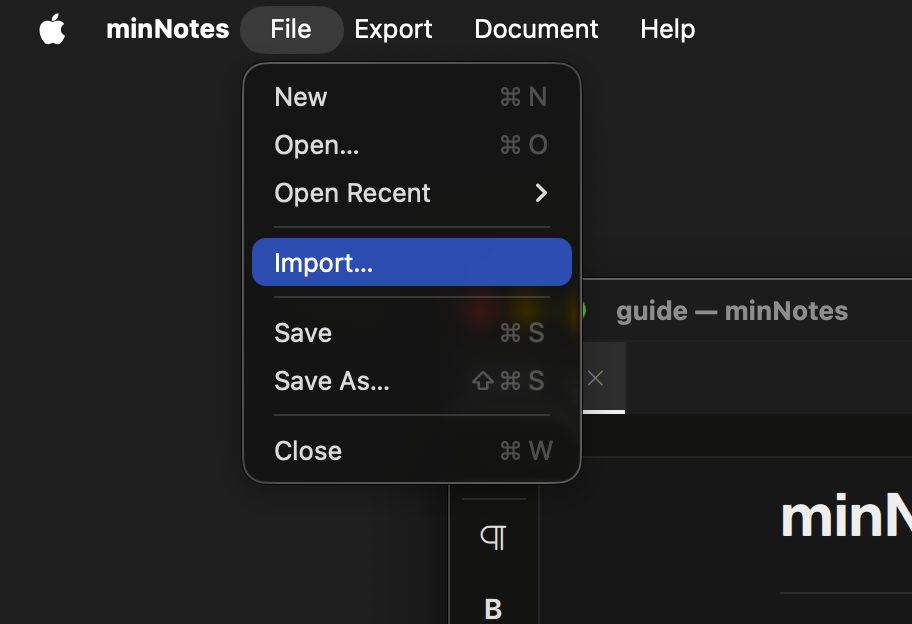
File ▸ Import… — or drop a file on the welcome screen, or drag one into a note — brings existing material in. A single file becomes a fresh untitled note (nothing touches disk until you save); an archive of many becomes a folder of notes.
| Format | Notes |
|---|---|
Markdown (.md) | GFM tables, fenced code with language, tri-state tasks |
Plain text (.txt) | Markdown-style prefixes convert on the way in |
| CSV / TSV | Becomes a table; first row is the header |
| HTML | Headings, lists, formatting, tables, images |
Word (.docx) | Round-trips minNotes’ own exports, including comments |
Excel (.xlsx) | Sheets become tables — including images in cells (both the floating and place-in-cell kinds) |
OpenDocument (.ods / .odt) | Calc sheets → tables; Writer docs with styles, lists, images |
| Source code | 37 languages → one syntax-highlighted code block |
| RTF | macOS only |
Evernote (.enex) | One note per entry; images and attachments come along |
Notion export (.zip) | Every page becomes a note; databases become tables |
Spreadsheet padding (empty rows and columns out to the sheet edge) is trimmed on the way in, and images referenced by imported documents are copied into the note’s media folder.
To bring an imported note into an existing note, import it to a tab and then drag the tab onto the destination — the whole thing merges where you drop it.